
Marble Installation
Bookmatched marble slab and tile installation for premium Accra residences, hotel lobbies and banking halls — set on a thin-set or mortar bed to ANSI A108, with impregnating sealers, efflorescence and moisture control, honing/polishing and movement joints. Floor Experts Ghana — over 30 years of flooring expertise.
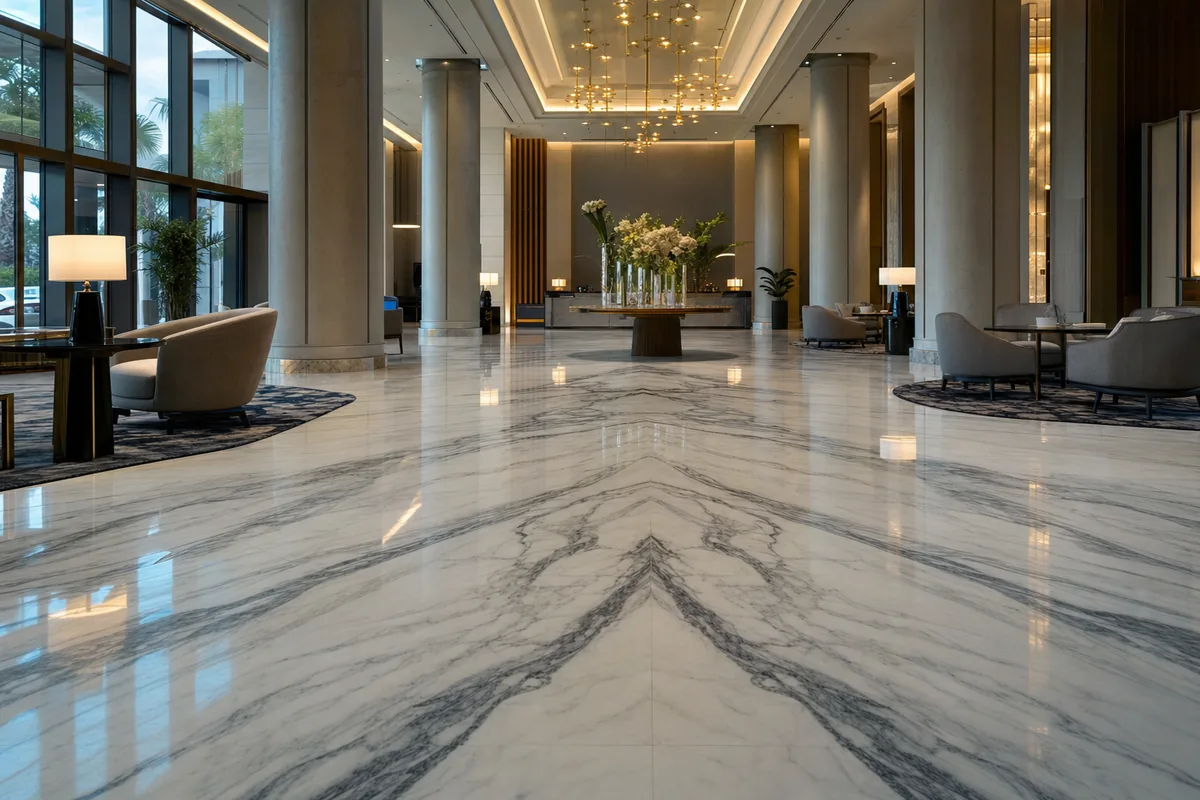
Marble installation is the precision setting of natural marble slabs and tiles — bookmatched for vein continuity, bedded on a thin-set or mortar bed to ANSI A108, then honed, polished and sealed — to the standard a premium Accra residence, hotel lobby or banking hall demands. Marble is a porous, calcareous stone, so its longevity is decided as much by moisture control and sealing as by the setting. Floor Experts Ghana has installed marble across Greater Accra for over three decades.
Why Marble Floors Fail in Ghana’s Conditions — and How We Prevent It
Marble rarely fails because the stone is wrong; it fails because it was treated like a ceramic tile. Marble is porous and calcareous: it stains from spills above and, just as often, from moisture and dissolved salts migrating up through the bed below — showing as white efflorescence, damp-staining and dark blotches that read straight through light stone. In Ghana’s persistent 81–83% humidity, a marble floor set on a moisture-laden substrate with a grey mortar and left unsealed is a floor that discolours within a season.
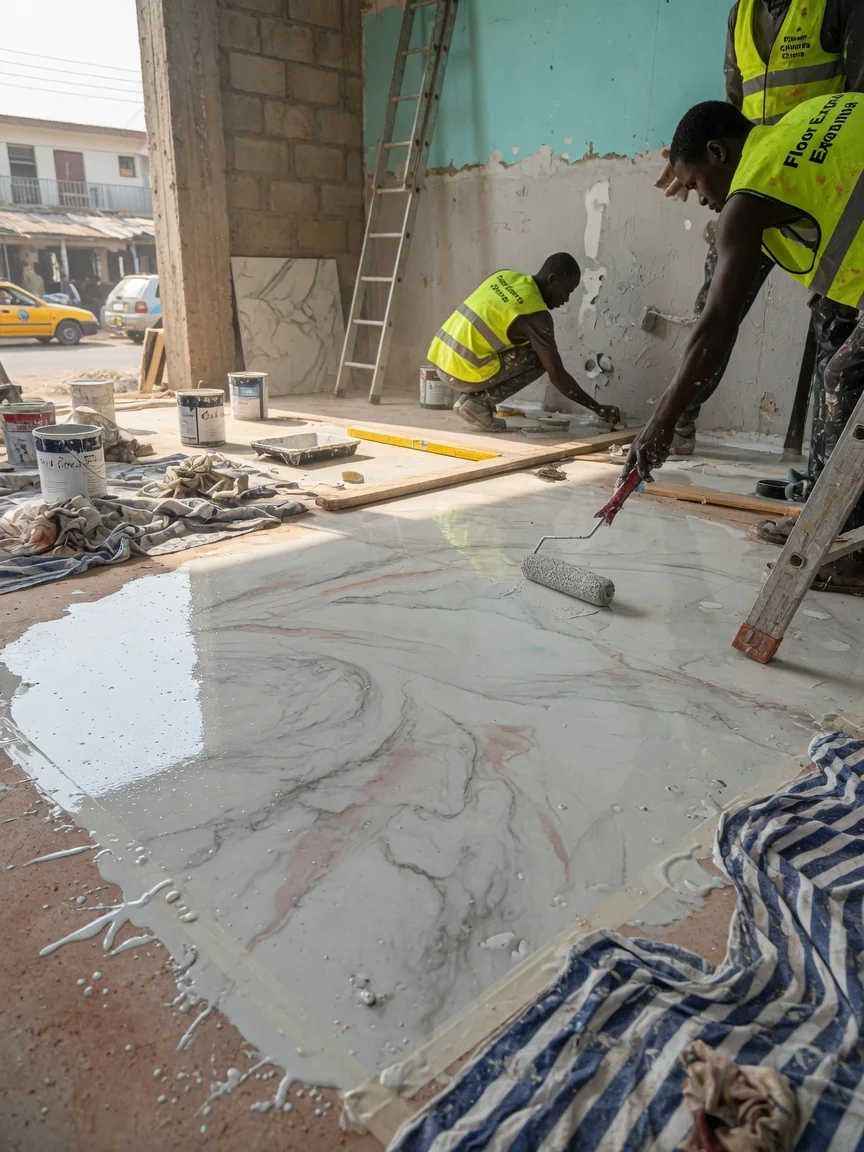
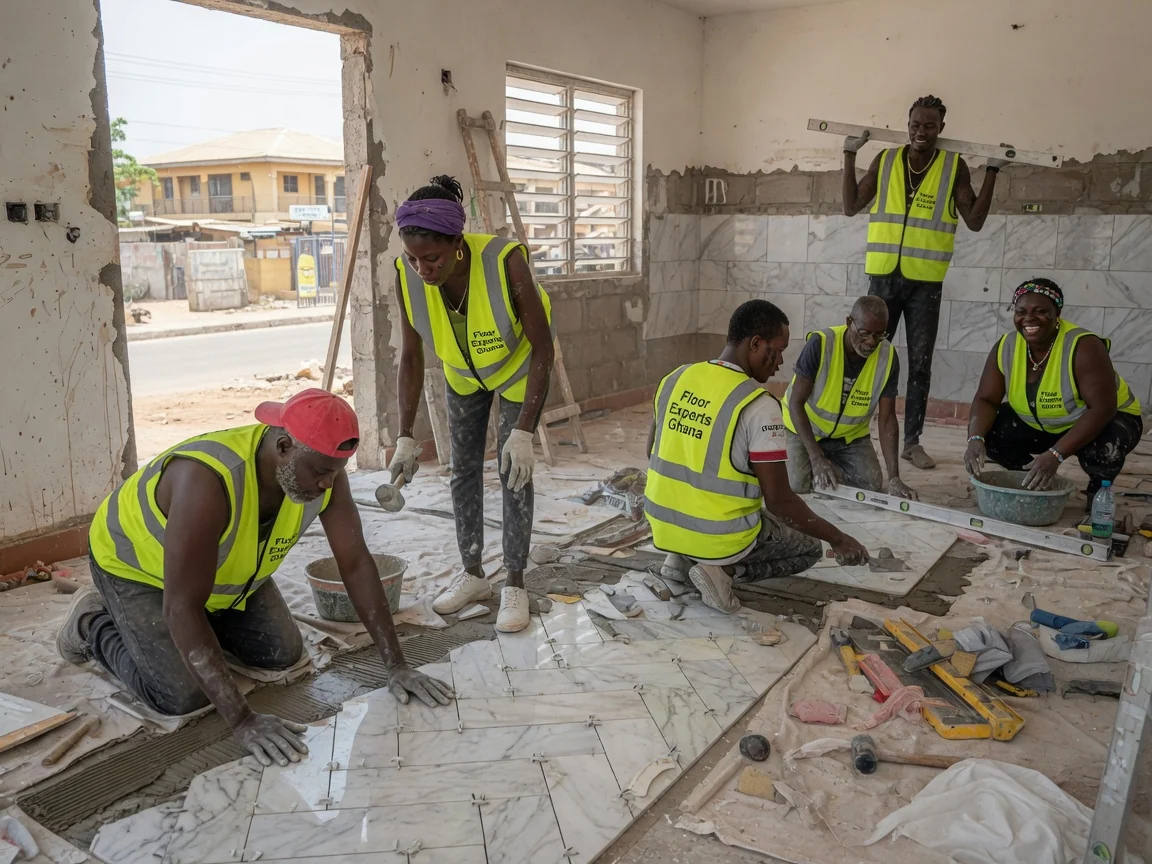
We treat substrate moisture control, mortar selection and sealing as the primary engineering controls. Marble is set to the ANSI A108 natural-stone method on a white polymer-modified mortar that resists efflorescence, the substrate is moisture-controlled, movement joints are planned, and the porous stone is protected with an impregnating (penetrating) sealer. That discipline — not the marble’s origin — is what keeps a marble floor reading clean for decades in this climate.
Marble Systems & Finishes We Install in Accra
Bookmatched Slab Floors
Large-format slabs sequenced and mirrored for continuous veining across reception halls, lobbies and feature floors — dry-laid and graded for tone before setting.
Calibrated Marble Tile
Honed or polished marble tile for bathrooms, kitchens and residential fields, set full-coverage on the correct mortar for a porous stone.
Honed & Polished Finishes
Honed for a soft matte surface that hides etching in working rooms; high-polish for the mirror finish a formal lobby demands — selected to the room and its use.
Feature & Inlay Work
Borders, medallions and stone inlay set to drawing, where marble is combined with contrasting stone for ceremonial and entrance floors.
The Marble Setting Standards We Work To
| Standard / control | What it governs | Why it decides the floor |
|---|---|---|
| ANSI A108 (natural stone) | Thin-set & mortar-bed setting methods | Full-coverage bedding for porous stone — the workmanship that prevents hollow spots and cracking |
| White polymer-modified mortar | Bond + efflorescence control | A non-staining, deformable mortar that will not bleed grey or salts up through light marble |
| Impregnating (penetrating) sealer | Stain & moisture resistance | Protects the porous calcareous stone from spills and damp-staining; periodically renewed |
| Substrate moisture control | Efflorescence prevention | Stops salt-laden moisture migrating up and discolouring the stone from beneath |
| Movement joints | Stress relief | Relieves thermal and structural movement so the bonded stone does not crack or tent |
How We Install a Marble Floor
- Slab selection, bookmatching & dry-lay — sequence for vein continuity, photograph, number and grade for tone before setting.
- Substrate prep & moisture control — flatness, soundness and moisture assessed; white mortar specified against efflorescence.
- Setting to ANSI A108 — full-coverage thin-set or mortar bed, with movement joints planned.
- Honing, polishing, sealing & handover — finish to specification, correct lippage, apply impregnating sealer, QC under raking light.
Comparing Premium Floor Stones for an Accra Home
| Stone | Character | Hardness / porosity | Best for |
|---|---|---|---|
| Marble | Bold veining, formal authority | Soft, calcareous, porous — etches with acids | Lobbies, formal reception, feature floors; honed in working rooms |
| Travertine | Warm, textured, ivory/walnut | Soft, porous, filled-and-honed | Reception, terraces, hospitality — warmer than marble |
| Granite | Speckled, very hard | Hard, low porosity | High-traffic, kitchens — tougher than marble |
| Porcelain (stone-look) | Marble appearance | Dense, ≤0.5% absorption | Low-maintenance alternative — see Premium Tile |
What Affects the Cost
- The marble grade and slab size, and whether bookmatching or feature/inlay work is specified
- Substrate condition, moisture control and any levelling required before setting
- The finish (honed vs polished), sealing, and movement-joint scope
- Area (m²), access, and whether the space stays in use during works
Every quote follows a site survey of the substrate and stone — no fixed rate is given before the floor is assessed.
Applications Across Ghana
- Premium residential reception and entrance floors across East Legon, Cantonments, Airport Residential and Trasacco
- Hotel and hospitality lobbies in bookmatched slab
- Banking halls, corporate receptions and institutional feature floors
- Bathrooms and kitchens in honed, sealed marble tile
Areas We Serve
Floor Experts Ghana installs marble across East Legon, Cantonments, Airport Residential, Ridge, Trasacco and Greater Accra — plus Kumasi, Cape Coast.
Related Services
- Travertine Flooring — warm filled-and-honed limestone for premium interiors
- Premium Tile — rectified porcelain and ceramic for residential and hospitality
- Heritage Stone Restoration — grinding, honing and re-sealing of aged stone floors
- Luxury Residential Floors — multi-material specification for premium homes
Frequently Asked Questions
Why does marble stain or show white marks after installation? Two preventable causes. Marble is porous and stains from spills unless protected with an impregnating sealer, and it shows efflorescence or damp-staining when substrate moisture and salts migrate up through the stone. We control substrate moisture, set on a white polymer-modified mortar, and seal the stone.
Should marble be sealed, and how often? Yes. Marble is calcareous and porous, so we apply an impregnating sealer at installation and recommend periodic re-sealing, with the interval confirmed on survey. Sealing slows staining and etching but does not make marble acid-proof.
Can marble go in a kitchen or bathroom in Ghana? Yes, with the right specification — honed marble hides etching, an impregnating sealer reduces staining, and the substrate must be moisture-controlled and, in wet zones, tanked.
How much does marble installation cost? It is quoted on survey — cost varies with the marble grade and slab size, bookmatching, substrate preparation and moisture control, honing/polishing and sealing, area and access. Request a site survey.