Le problème
Heritage-stone-restoration commissions require historically appropriate stone sourcing, traditional-tool methodology, and respect for the original installer's specification intent.
Notre approche
Floor Experts Ghana delivers heritage-stone-restoration through provenance-matched stone sourcing, hand-honed traditional methodology, and methodology-documented restoration aligned with castle-quarter heritage register.
Floor Experts Ghana delivers heritage-stone-restoration through provenance-matched stone sourcing, hand-honed traditional methodology, and methodology-documented restoration aligned with castle-quarter heritage register.
The Challenge
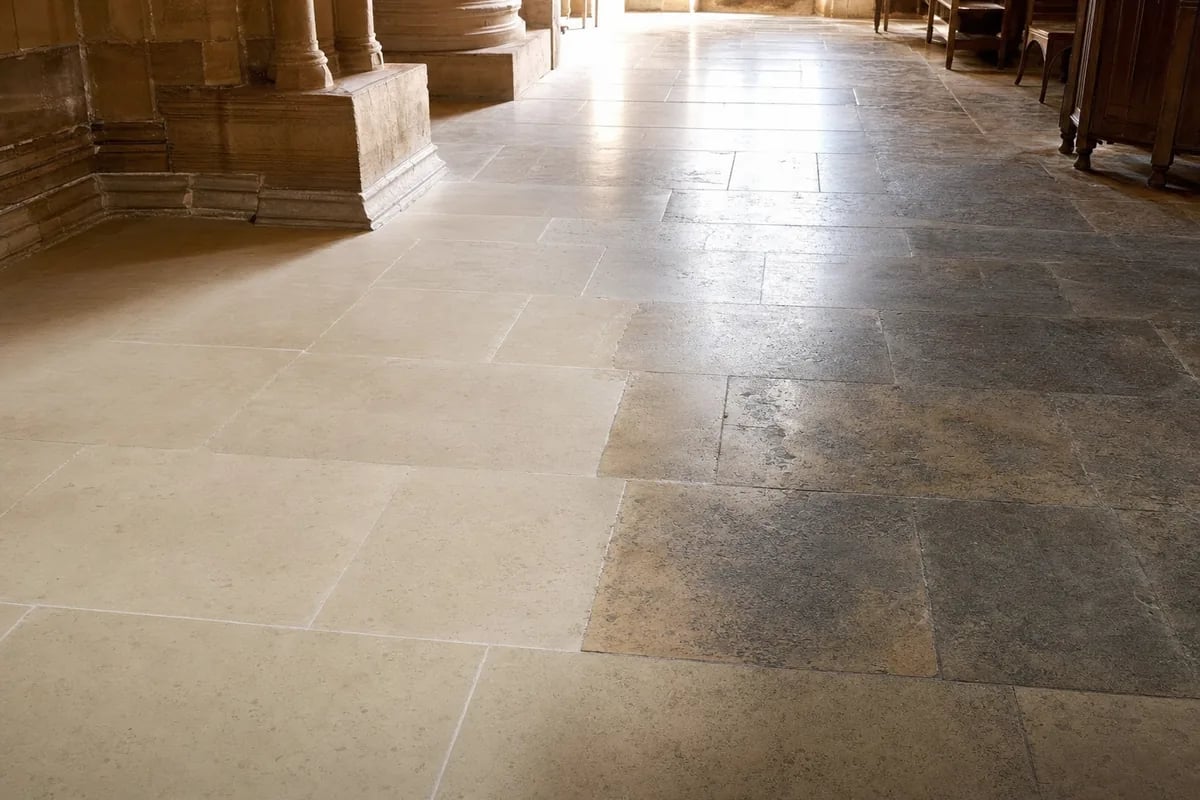
Historic stone floors carry a material record that no modern replacement can replicate. In Ghana’s coastal heritage quarters — Cape Coast, Elmina, and the older residential precincts of Accra — original limestone, sandstone, and hand-cut terracotta tile have survived decades of tropical humidity, salt-laden air, and the compounding stresses of successive occupancy. Yet survival is not preservation. Without specialist intervention, even structurally intact stone develops deep surface fatigue: mineralisation breaks down, grout matrices fail at the joint, and surface patina is lost to abrasive cleaning practices that were never specification-appropriate.
The heritage-conservation register compounds the technical challenge. Properties within or adjacent to declared heritage zones carry documentation obligations that go beyond standard refurbishment. Any restoration methodology must be provenance-matched — the materials introduced must be mineralogically compatible with the original substrate — and every phase of work must be capable of generating a methodology record sufficient for submission to a heritage register. Most flooring contractors lack either the stone-science background or the documentation discipline this demands.
Institutional clients — embassy residences, foundation-managed heritage buildings, high-value private estates within historic precincts — face a narrow field of credible options. The tolerance for error is zero: an incompatible consolidant can accelerate stone degradation; an incorrect grinding sequence can remove irreplaceable surface patina. The work demands a practice that has been doing this long enough to have encountered, and resolved, the full spectrum of failure modes.
The Floor Experts Ghana Solution
Floor Experts Ghana has carried specialist stone-restoration capability since the early years of practice, when the firm’s specialists first undertook documented restoration commissions in Ghana’s coastal heritage belt. For over three decades, that capability has been refined into a methodology that integrates provenance-matched stone sourcing, hand-honed traditional surface work, and a documentation protocol structured for heritage-register submission.
The process begins with a condition survey that classifies each stone unit by structural integrity, surface degradation category, and mineralogical composition. Replacement stone is sourced to match the original substrate in composition, finish, and regional provenance where supply permits. Consolidation uses penetrating mineral consolidants selected for compatibility with the host stone rather than off-the-shelf product convenience. Surface restoration proceeds through a controlled hand-honing sequence — machine work is limited to preparatory phases where surface geometry demands it; the final finish passes are hand-executed to preserve the tonal variation that defines heritage patina.
Every phase generates a written methodology record: materials used, application rates, drying intervals, before-and-after photographic documentation, and specifier sign-off at each milestone. The completed record is formatted for submission to the relevant heritage authority, providing the institutional client with a durable audit trail for the asset.
Material + System Specification
- Provenance-matched limestone, sandstone, and terracotta tile sourced to original substrate specification
- Penetrating mineral consolidants — selected by mineralogical compatibility, not generic product catalogue
- Hand-honed finish sequence — traditional methodology preserving original surface patina and tonal variation
- Hydraulic lime-based grout systems matched to joint width, colour, and period specification
- Breathable surface sealant — vapour-open formulation appropriate for humid coastal environments
- Phase-by-phase methodology documentation formatted for heritage-register submission
Typical Project Profile
A heritage stone restoration engagement typically covers 80 to 600 square metres across ground-floor reception, corridor, and principal room zones within a historic residence or institutional building. Programme duration runs from three to eight weeks depending on stone condition, replacement volume, and heritage-authority review intervals. Sectors served include diplomatic residences, foundation-managed heritage properties, premium private estates within coastal heritage precincts, and boutique lodges occupying listed or heritage-adjacent structures.
Outcomes
- Stone surface restored to period-accurate patina, with structural integrity documented at unit level
- Methodology record submitted and accepted by the relevant heritage register authority
- Grout and joint systems reinstated to period specification, eliminating infiltration risk
- Breathable sealant system extending stone service life without altering surface character
- Institutional client holds a complete audit trail — materials, methodology, sign-off — against the restored asset